
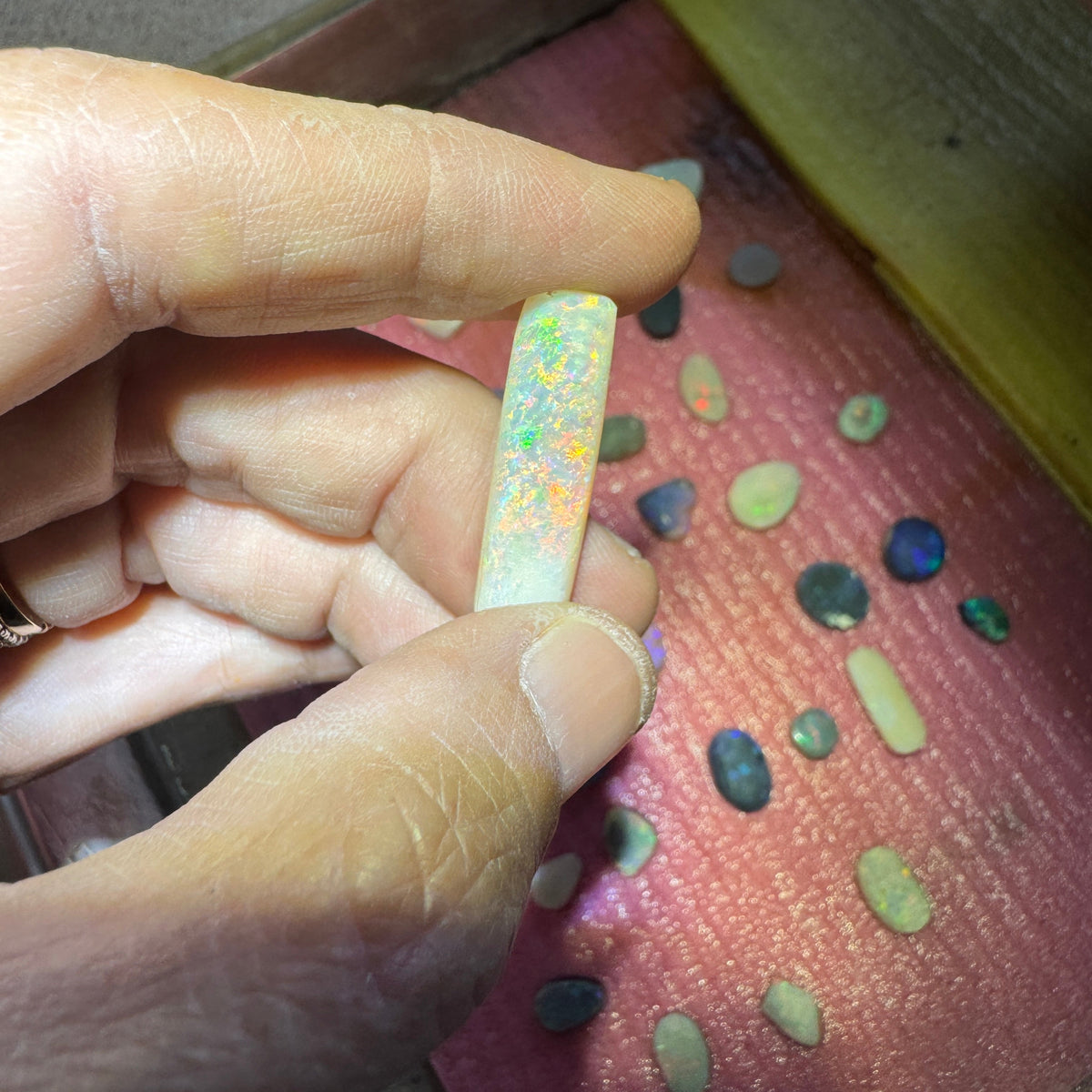
How I Decide Which Piece of Rough to Cut First
When a new parcel of rough lands on my bench, the hardest part isn't the cutting. It's deciding where to start. Every piece of rough is a set of possibilities, and the first cuts I make shape everything that follows. I thought I'd walk you through how I actually make that decision, because it's the part of the craft that people rarely get to see.
Reading the stone before touching the wheel
Before I cut anything, I spend time simply looking. I hold each piece up to the light, wet it to bring out the colour, and turn it slowly to see where the brightness lives and which way the colour bars run. Rough opal keeps its secrets close, and rushing this stage is how good stones get ruined.
What I'm trying to work out is where the best colour sits, how deep it goes, and what shape the finished stone wants to be. The rough tells you, if you're patient enough to listen. My job is to follow what's already there rather than force a stone into a shape it doesn't want.
Starting with the piece that teaches me the parcel
When a parcel comes from a single seam or field, the pieces often share characteristics. So I'll frequently begin with a stone that seems representative rather than the most valuable one. Cutting it shows me how the colour behaves, how the potch sits behind the bar, and how the material takes a polish. That knowledge then makes me a better cutter for every other piece in the lot.
It feels counterintuitive to start with a middling stone, but it protects the best ones. I'd far rather learn a parcel's quirks on a modest piece than discover them halfway through cutting something special.
Weighing risk against reward
Some rough offers a clear, safe stone with good but modest colour. Other pieces hint at something remarkable if I cut deep, but risk hitting sand or losing the colour entirely. Deciding which way to go is a judgement call every time, and there's no formula for it. Experience helps, but even after years I still get surprised, sometimes happily and sometimes not.
The stones that make my heart beat faster are the ones where the potential is obvious but so is the danger. Those are the pieces I sit with longest before I commit.
Letting some pieces wait
Not every stone gets cut straight away. Some I set aside because I'm not yet sure what they want to be, or because the right design hasn't come to me. There's no rush. An opal has waited millions of years already, and a few more weeks on my bench won't hurt it. Often the answer arrives when I'm not looking for it.
At Iona Opal Australia
Every finished piece I make began with this quiet process of looking, weighing and deciding. It's the part of the work I love most, and it's why no two of my stones are ever quite alike. If you'd like to see where that process leads, my handcrafted pieces are each the result of exactly these decisions, made one stone at a time.


Leave a comment
This site is protected by hCaptcha and the hCaptcha Privacy Policy and Terms of Service apply.