
The Difference Between Precious and Common Opal
People are often surprised to learn that a great deal of the opal in the world shows no play of colour at all. The word opal covers a wider family than most buyers expect, and understanding the line between precious and common opal is one of the first steps to knowing what you're really looking at.
What makes opal "precious"
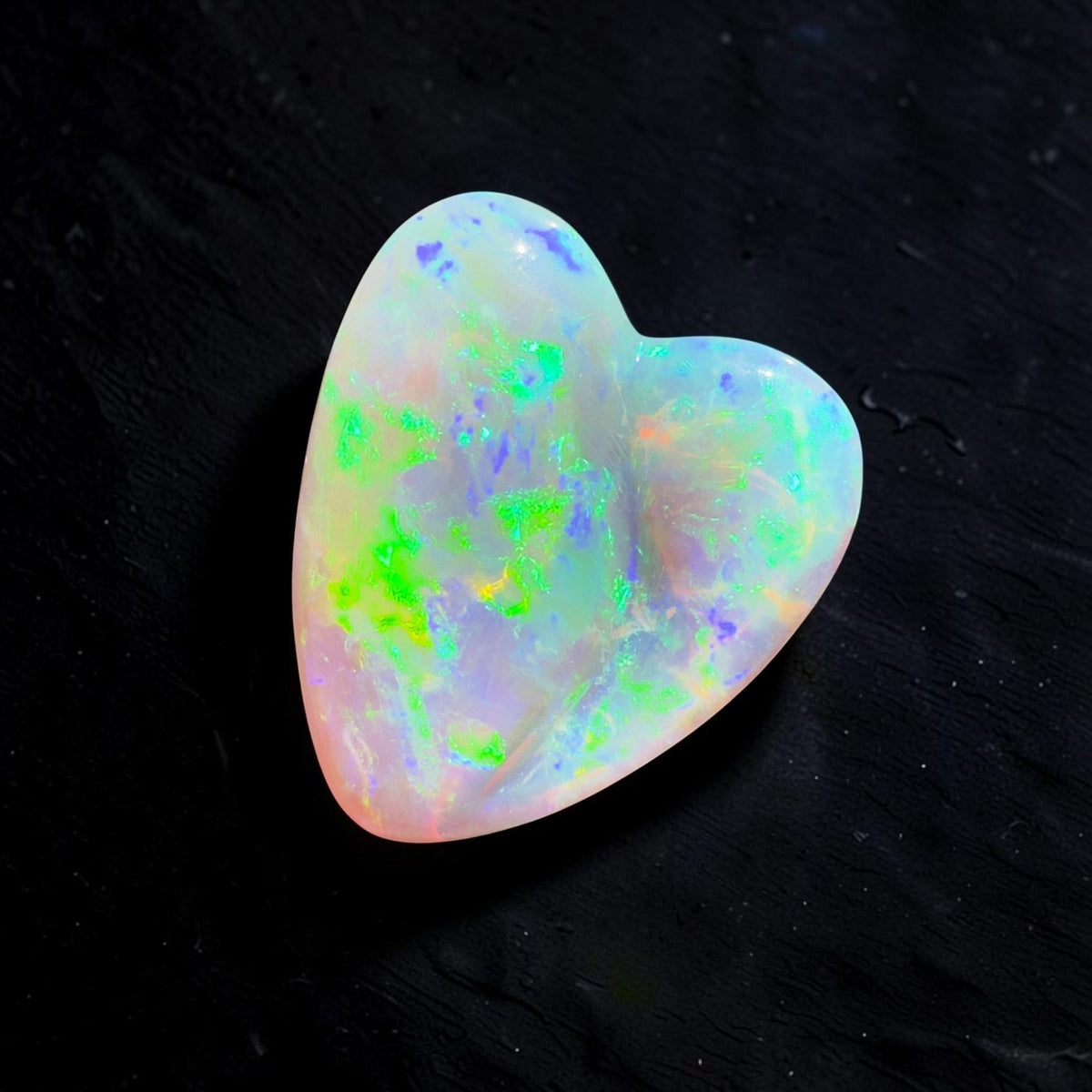
Precious opal is the kind everyone pictures: a stone that flashes with red, green, blue and gold as it moves. That play of colour comes from an orderly internal structure of silica spheres that bends light into a spectrum. When the spheres are uniform and neatly arranged, you get colour. When they're not, you don't. It's as simple and as demanding as that.
This is the opal that goes into fine jewellery and the opal I spend my days cutting. Its rarity comes from just how particular the conditions have to be for that colour-producing structure to form.
What common opal is
Common opal, sometimes called potch, has the same basic chemistry but lacks the ordered structure, so it shows no play of colour. It can still be attractive in its own quiet way, coming in milky whites, greys, honey tones and more, and some varieties are used decoratively. But it doesn't have the shifting fire that defines precious opal.
Potch isn't worthless or dishonest. It forms right alongside precious opal in the fields, and in a solid stone the potch backing is often what gives the colour something to sit against. It simply isn't the same thing as the gem-quality material.
Why the distinction matters when buying
Knowing the difference protects you. Here's what to keep in mind:
- Play of colour is the dividing line. If a stone genuinely flashes with shifting colour, it's precious opal. If it's a solid single colour with no play, it's common opal.
- Price should follow. Precious opal commands far more than common opal, so the two should never be priced alike.
- Words can blur it. Terms are sometimes used loosely. If you're unsure, ask directly whether a stone shows play of colour.
Where potch earns its place
I want to be fair to common opal, because it's part of the story. The dark potch behind a fine black opal is doing important work, giving the colour a rich background to glow against. In boulder opal, the natural host material is central to the stone's character. Common opal isn't a lesser trick played on buyers; it's simply a different member of the same family.
At Iona Opal Australia
Every stone I sell as precious opal genuinely shows play of colour, because I cut it and I've watched that colour come alive under my wheel. I'll always tell you plainly what a stone is. Understanding precious versus common opal is one of the simplest, most useful things a new buyer can learn, and I'm glad to help you see the difference for yourself.


Leave a comment
This site is protected by hCaptcha and the hCaptcha Privacy Policy and Terms of Service apply.