
Article: Understanding Opal Weight — Why Carats Tell You Less Than You Think
Understanding Opal Weight — Why Carats Tell You Less Than You Think
If you've bought a diamond, you'll know that carat weight is one of the first things anyone mentions. It's a headline number that carries a lot of meaning. With opal, weight matters too, but it can quietly mislead you if it's the only thing you look at. Here's why.
Carats measure weight, not what you see
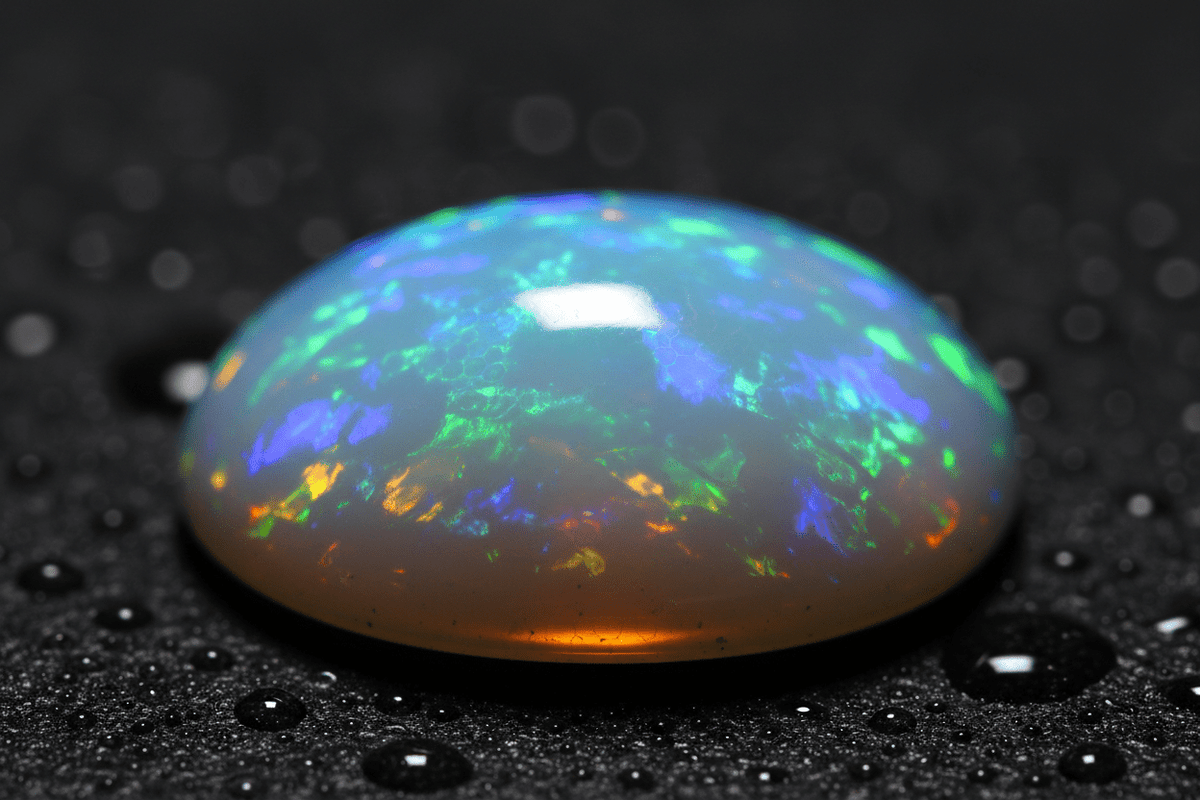
A carat is simply a unit of weight, one fifth of a gram. For a diamond, cut to fairly standard proportions, weight and visible size line up reasonably well. Opal is different. Opals are cut freely to follow their colour, so two stones of the same carat weight can look very different in size depending on their shape and how deep they are.
A deep stone carries a lot of its weight underneath, where you never see it. A flatter stone of the same weight can present a much larger face. So when you're comparing opals, the carat figure alone won't tell you which will look bigger once it's set.
What actually drives an opal's value
Weight is only one factor, and rarely the most important. The things that move an opal's value most are:
- Body tone — how dark the background is, on the N1 to N9 scale. Darker stones show colour more vividly and are generally rarer.
- Brightness — how vivid the play of colour is, rated from B1 (brilliant) to B7 (subdued).
- Colour — red and orange are the rarest and most prized; blue and green are more common.
- Pattern — large, distinct patterns like harlequin are far rarer than fine pinfire.
A small, brilliant red-on-black stone can be worth many times more than a large, pale one. Size simply doesn't sit at the top of the list the way it does with some other gems.
Why "spread" is the number to ask about
If size is what you care about, the useful measurement is the stone's dimensions, its length and width, sometimes called the spread, rather than its carat weight. That tells you how much opal you'll actually see once it's set. A good seller will happily give you the dimensions alongside the weight.
This is also why a heavier stone isn't automatically a better buy. You could be paying for depth that adds weight but nothing to the beauty of the finished piece.
At Iona Opal Australia
When I describe a stone, I'll always tell you its dimensions as well as its weight, because I want you to know what you'll really see when you wear it. I cut every opal by hand to make the most of its colour, not to chase a bigger number on the scale. Buy the stone that speaks to you, not the one with the largest carat figure.

Leave a comment
This site is protected by hCaptcha and the hCaptcha Privacy Policy and Terms of Service apply.