
Why No Two Opals Are Ever the Same
Walk into any opal collection and you'll hear the same thing said about almost every stone: there's nothing else quite like it. That's not sales talk. It's geology. No two opals on earth are identical, and understanding why makes the stone even more remarkable.
It Starts with Water
Opal forms when silica-rich water seeps into cracks and voids in rock — usually sandstone or ironstone — and slowly evaporates over millions of years. As the water retreats, it leaves behind a lattice of tiny silica spheres stacked in layers. The size and arrangement of those spheres determine the colours you see. Change the arrangement even slightly, and you get an entirely different stone.
No Two Conditions Are Ever the Same
The temperature, the mineral content of the water, the speed of evaporation, the shape of the cavity, the surrounding rock — every variable affects the final result. Even two opals found metres apart in the same mine will have formed under subtly different conditions. That's why miners can open a seam and pull out stones that look nothing like each other, despite sitting side by side for 100 million years.
The Colour Play Is Unrepeatable
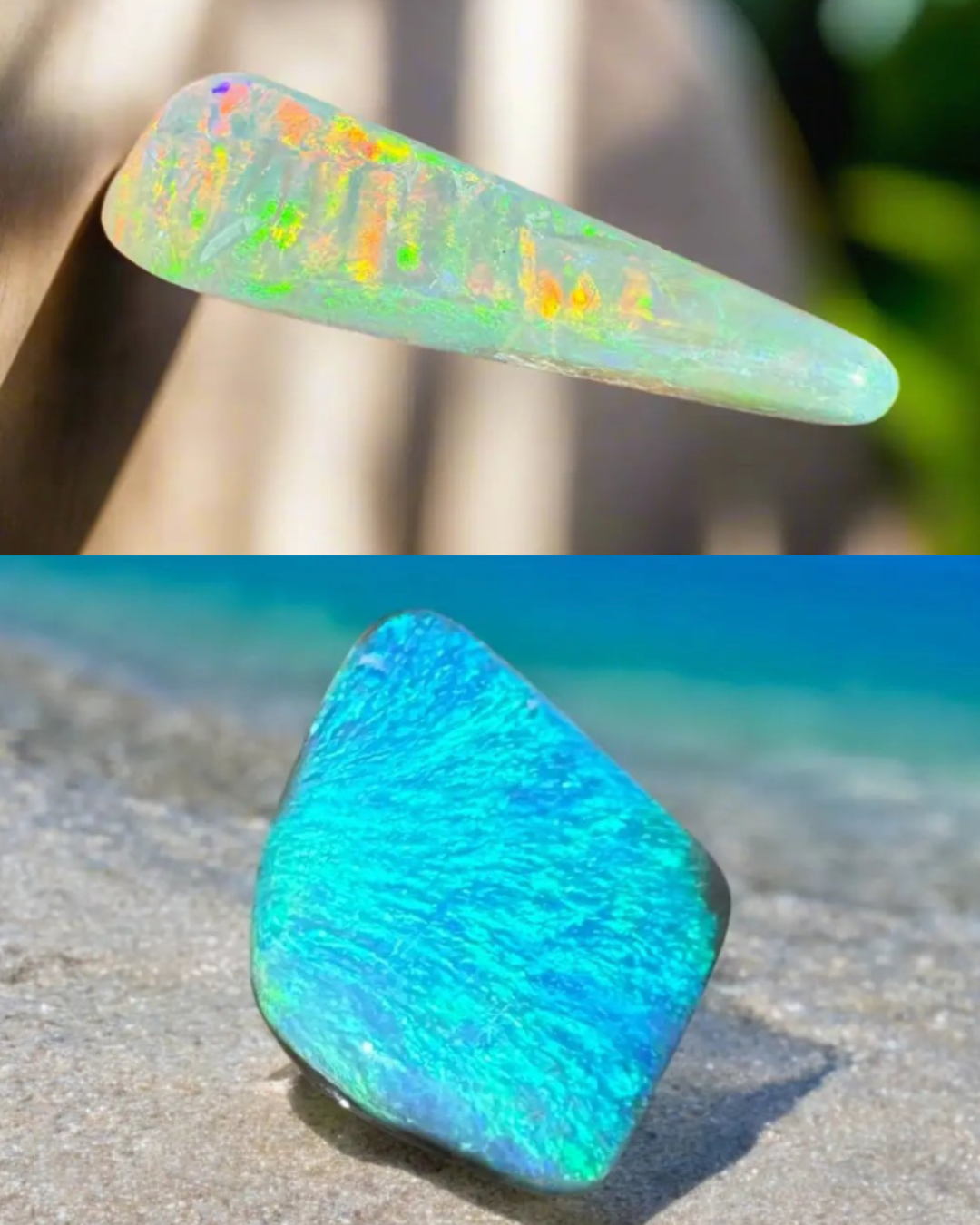
What we call "colour play" or "fire" is the result of light diffracting through that silica lattice. When the spheres are a consistent size and evenly stacked, the light bends into colour. Slightly different sphere sizes produce different colours. The pattern — whether it's rolling, harlequin, pinfire, or broad flash — is entirely determined by how those layers formed. No machine can replicate it. No other stone in nature produces it the same way.
Even the Same Stone Looks Different in Different Light
Tilt a solid opal slightly and it transforms. A stone that's blazing red under artificial light might shift to violet and green in sunlight. The stone hasn't changed — you've just moved the angle of the light hitting the lattice. You can spend years looking at the same opal and still catch it doing something new.
What This Means for You
When you choose a solid Australian opal, you're choosing something that exists once. There is no other stone with that exact pattern, those exact colours, that exact internal structure. It was formed over millions of years in a specific pocket of Australian earth, and it will never be replicated. That's not a selling point — it's just the truth of what opal is.
Browse one-of-a-kind solid Australian opals at Iona Opal Australia →

Leave a comment
This site is protected by hCaptcha and the hCaptcha Privacy Policy and Terms of Service apply.